100+ Digital Marketing Statistics You Need to Know
Every year, someone on your team asks the same question in a budget meeting: “Where should we actually put our money?” This year, that question is harder to answer than usual.
Search results now show AI-generated answers before a single blue link. Ad costs are climbing even as click-through rates rise. Social platforms are splitting audiences across five formats at once. And most marketing teams are trying to make sense of all of it with data that’s already six months stale by the time it lands in a slide deck.
That’s the gap this report is built to close.
We pulled together data from Ahrefs, Semrush, BrightEdge, HubSpot, WordStream, BrightLocal, Sprout Social, Backlinko, McKinsey, and dozens of other primary sources, then organized it into one working reference you can actually use — not just skim. No recycled numbers from 2021. No vague “marketers say” claims without a source behind them.
Why does this matter right now? Because 2026 is the first year where AI search behavior, not just Google rankings, materially changes how much traffic your website earns. Businesses that adjust their SEO, content, and paid strategy around this shift are pulling ahead. Businesses that don’t are watching their numbers quietly erode, often without knowing why.
Whether you’re a business owner setting next quarter’s budget, a marketing manager reporting to leadership, an SEO professional building a client case, or a startup deciding where the first marketing dollar goes — this guide gives you the numbers, what they mean, and what to do about them.
Quick Summary: Top 10 Key Findings
- Organic search remains the largest single traffic source for most businesses, though its share is under pressure from AI-generated answers.
- AI Overviews now appear on a large share of Google searches and measurably reduce click-through rates on informational queries.
- Nearly nine in ten marketers now use generative AI in at least one part of their workflow, up sharply from just two years ago.
- Local intent drives close to half of all Google searches, and a complete Google Business Profile significantly increases visibility.
- Content marketing continues to deliver a stronger return than paid advertising, though only a minority of marketers can accurately measure that return.
- Backlinks remain one of Google’s strongest ranking signals, but the vast majority of published pages still earn zero of them.
- Average Google Ads costs per click have risen again this year, even as AI-assisted bidding helps offset some of the increase.
- Short-form video continues to post the highest engagement rates of any social content format.
- Zero-click searches are now common enough that visibility, not just clicks, has become a metric marketers need to track.
- Businesses using an integrated strategy across SEO, content, PPC, local, and social consistently outperform those running channels in isolation.
Table of Contents
- SEO Statistics
- AI Search Statistics
- Local SEO Statistics
- Content Marketing Statistics
- Link Building Statistics
- PPC Statistics
- Social Media Marketing Statistics
- Future Digital Marketing Trends
- Geniefolks Industry Insights
- Key Takeaways
- FAQs
SEO Statistics
Search engine optimization is still the channel most businesses lean on for sustainable, compounding traffic. But the mechanics behind it have shifted meaningfully this year.
Statistics:
| SN. | Statistic | Source |
|---|---|---|
| 1 | Organic search drives roughly 53% of all trackable website traffic globally, ahead of paid search, social, and direct traffic combined | BrightEdge |
| 2 | For B2B companies specifically, organic search accounts for closer to 64% of total traffic | BrightEdge |
| 3 | Google holds around 90–91% of global search engine market share across all devices | StatCounter |
| 4 | 92% of marketers plan to maintain or increase SEO spending this year despite AI search disruption | AIOSEO |
| 5 | Roughly 96.5% of all indexed pages receive zero organic search traffic from Google | Ahrefs |
| 6 | The global SEO services market is now valued between $84 billion and $108 billion, depending on methodology | Industry composite |
| 7 | SEO delivers a median three-year ROI of around 748% for B2B companies, according to campaign-level analysis | First Page Sage |
| 8 | 87% of marketers now use AI tools to help create or assist with content | Ahrefs |
| 9 | Somewhere between 58% and 62% of Google searches end without a click to any website, though estimates vary by methodology | SparkToro / industry composite |
| 10 | Position-one pages carry, on average, 3.8 times more referring domains than pages ranked two through ten | Backlinko / Adilo |
| 11 | Businesses allocate roughly 10–20% of their total digital marketing budget to SEO activities | Industry composite |
| 12 | Enterprise organizations often spend $100,000 or more annually on SEO programs | Industry composite |
| 13 | Only about 14% of marketers currently track their visibility inside AI-generated search results | Macro Digital / industry composite |
| 14 | SEO delivers 1,000%+ more traffic than organic social media on a like-for-like basis | BrightEdge |
| 15 | Organic search traffic converts at roughly 2.4% on average for e-commerce websites | Web Tonic |
Expert Analysis:
What this data means: SEO hasn’t lost its role as the primary discovery channel — it’s still the single biggest source of trackable traffic for most businesses. What has changed is the shape of that traffic. Fewer searches end in a click, more visibility gets absorbed into AI-generated answers, and the gap between page-one and page-two performance keeps widening.
How businesses can use it: Treat rankings as one input, not the whole scoreboard. Track impressions and visibility alongside clicks, and prioritize the content types — comparison pages, service pages, FAQs — most likely to earn both organic clicks and AI citations.
Geniefolks expert opinion: We tell clients the same thing every quarter — SEO isn’t getting less valuable, it’s getting more technical. The businesses winning in 2026 are the ones treating on-page structure, page speed, and topical depth as non-negotiable basics, not “nice to have” line items.
Actionable recommendation: Audit your top 20 landing pages for search intent match and technical health this quarter — a mismatch here is usually the fastest fix available to recover lost rankings. Our SEO services team can run this audit for you.
Key Takeaway: Organic search still drives more traffic than any other channel — but ranking on page one now matters less than ranking on page one and getting cited inside AI-generated answers.
AI Search Statistics
Search behavior itself is being rewritten by AI Overviews, chat-based assistants, and answer engines. This is the fastest-moving category in this report.
Statistics:
| SN. | Statistic | Source |
|---|---|---|
| 16 | AI Overviews now appear on roughly 13% of all tracked Google queries, with far higher rates on informational searches | BizIQ / GoodFirms |
| 17 | B2B technology-related queries trigger AI Overviews around 82% of the time; healthcare queries around 88% | Omnibound |
| 18 | When an AI Overview appears, users click through to a traditional organic result only about 8% of the time | Seer Interactive |
| 19 | Average organic click-through rate on affected queries has dropped from roughly 15% to 8% once an AI Overview is present | BizIQ |
| 20 | Zero-click search behavior on desktop and mobile combined has climbed from roughly 56% to 69% over the past two years, per clickstream analysis | Similarweb |
| 21 | Around 46.5% of pages cited inside AI Overviews rank outside the top 50 traditional organic results — meaning AI citation can surface pages that wouldn’t otherwise get found | GoodFirms |
| 22 | Only 40.65% of website traffic today comes from organic search, while roughly 0.26% currently comes from AI referral traffic directly | Ahrefs |
| 23 | About half of marketers surveyed report a drop in traditional search traffic alongside a rise in AI-driven referral traffic | Ahrefs |
| 24 | Brand-owned content represents only 5–10% of the sources AI engines actually cite for consumer product queries | McKinsey |
| 25 | 87% of marketers now use generative AI in at least one part of their workflow, up from 51% just two years ago | Salesforce State of Marketing |
| 26 | Position-one click-through rates can fall by as much as 58–61% on queries where an AI Overview is present | Ahrefs |
Expert Analysis:
What this data means: AI search isn’t a future trend — it’s already reshaping click behavior today, particularly for informational queries. The businesses most exposed are the ones relying entirely on top-of-funnel blog traffic without a plan for AI citation or commercial-intent conversion.
How businesses can use it: Separate your content strategy into two lanes — content built to earn AI citations (definitions, comparisons, data) and content built to convert (service pages, pricing, case studies). Protect the second lane fiercely; it’s less exposed to AI Overview cannibalization.
Geniefolks expert opinion: This is the conversation we’re having with almost every client right now. The instinct is to panic about lost clicks — the smarter move is to figure out which of your pages AI engines are already citing, and double down on making those pages more authoritative.
Actionable recommendation: Check Google Search Console for queries where your impressions are climbing but clicks are flat — that’s your AI Overview exposure list, and it’s the first place to strengthen content depth and structured data.
Key Takeaway: AI Overviews are cutting organic click-through rates on informational content — but they’re also creating a new visibility channel for pages that never used to rank at all.
Local SEO Statistics
For any business with a physical location or a defined service area, local search is where discovery turns into revenue fastest.
Statistics:
| SN. | Statistic | Source |
|---|---|---|
| 27 | Roughly 46% of all Google searches carry local intent | BrightLocal |
| 28 | 76% of mobile users who run a local search visit a physical business location within 24 hours | Google / BrightLocal |
| 29 | Businesses with a fully completed Google Business Profile receive about 70% more location visits than those with incomplete profiles | BizIQ |
| 30 | The Local 3-Pack appears at the top of results for roughly 93% of local-intent queries | BizIQ |
| 31 | Local SEO can produce a cost-per-lead around 61% lower than traditional outbound marketing for small businesses | BizIQ |
| 32 | Ranking inside the Local Pack correlates with roughly 126% more traffic than businesses that don’t appear there | SOCi |
| 33 | Around 97% of consumers say they read reviews for local businesses at least occasionally | Resourcera |
| 34 | 41% of consumers now say they “always” read reviews before choosing a local business, up sharply from the prior year | BrightLocal |
| 35 | Businesses ranking in the top three local positions carry an average of several hundred Google reviews | Semrush |
| 36 | There’s roughly a 3% lift in Google Business Profile conversions for every additional 10 reviews a business earns | SOCi |
| 37 | An average Google Business Profile generates around 59 monthly actions — a mix of website clicks, direction requests, and calls | SQ Magazine |
| 38 | “Near me” mobile search volume has grown roughly 900% over the past two years | BizIQ |
| 39 | More than half of local search terms now trigger an AI Overview in results | SeoProfy |
| 40 | Google Business Profile signals account for roughly 32% of total local pack ranking weight | Whitespark |
Expert Analysis:
What this data means: Local search rewards completeness and freshness more than almost any other SEO discipline. A profile that’s 80% filled out is meaningfully weaker than one that’s fully optimized — and the gap shows up directly in visits and calls, not just rankings.
How businesses can use it: Treat your Google Business Profile as a living asset, not a set-and-forget listing. Weekly posts, fresh photos, and prompt review responses all measurably affect visibility.
Geniefolks expert opinion: Local SEO is the fastest ROI channel we run for clients with physical locations — and it’s also the most commonly neglected. Most businesses set up their profile once and never touch it again, which is exactly where competitors quietly overtake them.
Actionable recommendation: Audit your Google Business Profile completeness score this week and set a recurring monthly reminder to add new photos and respond to every review. Our local SEO services team builds this into an ongoing local visibility system.
Key Takeaway: Nearly half of all Google searches have local intent — and a complete, active Google Business Profile is the single highest-leverage local SEO services activity available.
Content Marketing Statistics
Content remains the engine behind organic growth, but the return on that investment now hinges heavily on consistency and measurement.
Statistics:
| SN. | Statistic | Source |
|---|---|---|
| 41 | Content marketing delivers an average return of roughly $7.65 for every $1 spent, compared to roughly $1.80 for paid advertising | Revenue Memo |
| 42 | Companies that maintain an active blog generate around 67% more monthly leads than non-blogging competitors | Firework / Omnibound |
| 43 | Active blogging businesses also see roughly 55% more website traffic than peers who don’t publish | Firework |
| 44 | Content marketing generates over 3 times as many leads as outbound marketing, at roughly 62% lower cost | Demand Metric |
| 45 | Businesses that publish original research report roughly 64% higher conversion rates and 61% stronger SEO performance than those that don’t | Typeface / CMI |
| 46 | Only about 36% of marketers say they can accurately measure content marketing ROI | Genesys Growth / CMI |
| 47 | 56% of B2B marketers say they struggle with content attribution across channels | CMI |
| 48 | Website, blog, and SEO content ranks as the #1 ROI-generating channel among surveyed marketers, ahead of paid social and email | HubSpot |
| 49 | Short-form video is now named the top-ROI content format by roughly half of marketers surveyed | HubSpot |
| 50 | 90% of marketers report a positive return from video content, and 85% plan to maintain or increase video spend | Realize |
| 51 | Consistent, regularly-publishing blogs are associated with as much as 13 times higher positive ROI than sporadic publishing | Firework |
| 52 | Email marketing, while a distribution channel rather than content itself, delivers roughly $36–$42 in return per $1 spent when paired with strong content | OptinMonster / Firework |
| 53 | B2C content marketers report content strategy success at a notably higher rate than B2B marketers — 43% versus 32% | Siege Media / Wynter |
| 54 | AI-assisted content workflows have cut production costs by roughly 68% for some enterprise teams | Revenue Memo |
Expert Analysis:
What this data means: Content marketing’s ROI advantage over paid channels is real and well-documented — but that advantage compounds over months, not weeks, and most teams still can’t prove it in a spreadsheet. Measurement, not content quality, is the actual bottleneck for most organizations.
How businesses can use it: Before creating more content, fix your attribution setup. Tag content-driven leads distinctly from paid or direct leads so the ROI conversation has real numbers behind it, not assumptions.
Geniefolks expert opinion: We see this gap constantly — clients producing genuinely strong content but unable to show leadership what it’s actually worth. Fixing measurement often does more for a content program’s survival than doubling the publishing calendar.
Actionable recommendation: Set up UTM tracking and a simple content-to-lead attribution dashboard before your next content sprint — it changes every future budget conversation. Explore our content marketing services for a done-for-you framework.
Key Takeaway: Content marketing consistently outperforms paid advertising on ROI — but only businesses that measure it properly can prove that value to decision-makers.
Link Building Statistics
Backlinks remain one of Google’s most influential ranking signals, even as AI reshapes how content gets discovered.
Statistics:
| SN. | Statistic | Source |
|---|---|---|
| 55 | Roughly 95–96.5% of all web pages have zero backlinks pointing to them | Ahrefs |
| 56 | The #1 ranked Google result carries, on average, 3.8 times more backlinks than pages ranked second through tenth | Backlinko (11.8M search results analyzed) |
| 57 | Pages with at least one backlink are roughly 77% more likely to rank in the top 10 than pages with none | PressWhizz / Backlinko |
| 58 | Referring domains show the strongest correlation with rankings of any ranking factor Ahrefs tracks | Ahrefs |
| 59 | Only around 2.2% of published content earns links from more than one referring domain | Ahrefs Content Explorer |
| 60 | Long-form content (3,000+ words) earns roughly 3.5 times more backlinks than short-form content | PressWhizz |
| 61 | Digital PR is now rated the most effective link-building tactic by roughly 48.6% of SEO professionals, ahead of guest posting | Editorial.link |
| 62 | Guest posting is still used by roughly 65% of marketers, despite ranking behind digital PR in effectiveness | Authority Hacker |
| 63 | 78.1% of SEO professionals report a satisfying ROI from their link-building programs | LinkBuild.agency |
| 64 | Original research and data-driven “statistics” pages attract roughly 200% more links on average than standard blog content | PressWhizz |
| 65 | 73.2% of SEO professionals believe backlinks still influence how AI search engines choose citations | LinkBuild.agency |
| 66 | The global link-building services market is estimated at roughly $26 billion, projected to more than double by 2030 | LinkBuild.agency |
| 67 | 47.8% of SEOs consider link building the single most difficult part of SEO work | PressWhizz |
| 68 | Pages that already rank well gain an average of 5–14.5% more referring domains per month, compounding their advantage over time | Ahrefs / Searchlab |
Expert Analysis:
What this data means: Backlinks haven’t lost their power — they’ve just gotten harder to earn cheaply. The tactics that used to work at scale (mass guest posting, low-effort directories) are being outpaced by digital PR and genuinely link-worthy assets like original data and tools.
How businesses can use it: Redirect link-building budget away from volume tactics and toward one or two high-quality linkable assets per quarter — an original survey, a benchmark report, or an interactive tool.
Geniefolks expert opinion: The clients who ask us for “50 backlinks a month” almost always get outperformed by the ones who ask for one really strong piece of original research. Quality compounds; quantity plateaus.
Actionable recommendation: Identify one data set, survey, or process unique to your business that could become a linkable asset this quarter — that single piece often earns more authority than a year of generic outreach.
Key Takeaway: The vast majority of web pages have zero backlinks — earning even a handful of high-quality links puts a page ahead of nearly all of its competition.
PPC Statistics
Paid search costs keep climbing, but the businesses tracking the right metrics are still finding efficient ways to grow through it.
Statistics:
| SN. | Statistic | Source |
|---|---|---|
| 69 | The average Google Ads Search cost-per-click across industries reached roughly $2.96–$5.42 in 2026, depending on measurement methodology | WordStream / ClickMinded |
| 70 | Average Search CPC rose approximately 12% year-over-year, one of the steepest annual increases recorded since 2021 | Digital Applied |
| 71 | The all-industry average Google Ads conversion rate sits around 8.18%, with wide variation by industry | WordStream |
| 72 | Cost per lead fell for the first time in five years, landing at roughly $66.69 across the industries tracked | WordStream |
| 73 | AI-powered bidding — Smart Bidding and Performance Max — now drives roughly 78% of total Google Ads spend | Digital Applied |
| 74 | Advertisers using AI bidding strategies report roughly 22% lower cost per conversion on average compared to manual bidding | Digital Applied |
| 75 | Average cost per click ranges from about $1.16 in e-commerce to as high as $8.58 in legal services | Foundry CRO |
| 76 | 68% of all Google Ads clicks now come from mobile devices, carrying roughly a 5% higher CPC than desktop | Searchlab |
| 77 | Paid click-through rate on AI Overview-affected queries has fallen from around 19.7% to roughly 6.3%, compressing the value of a shrinking number of paid slots | Seer Interactive / The Ad Spend |
| 78 | Shopping ad CPCs run roughly 40–55% lower than standard search ad CPCs | Searchlab |
| 79 | Small businesses typically spend $1,500–$5,000 per month on Google Ads; enterprise advertisers often invest $15,000–$100,000+ | Searchlab |
| 80 | Conversion rates declined in 13 of 14 industries tracked in 2026, even as click-through rates rose — pointing to a landing page problem rather than an ad problem | Foundry CRO |
Expert Analysis:
What this data means:
Rising CPCs don’t automatically mean rising costs per lead — conversion rate optimization is now doing more to protect ROI than bid strategy alone. The businesses seeing the biggest CPC pain are usually the ones sending paid traffic to weak or generic landing pages.
How businesses can use it: Before increasing budget to compensate for higher CPCs, audit your landing page conversion rate first. A five-point conversion rate improvement often outperforms a 20% budget increase.
Geniefolks expert opinion: Every PPC account we take over follows the same pattern — strong ad copy, mediocre landing page, wasted spend. Fixing the page is almost always cheaper than fixing the auction.
Actionable recommendation: Pull your last 90 days of Google Ads data and sort by CTR versus conversion rate — any campaign with high CTR and low conversion rate needs a landing page rebuild before another dollar of budget. Our PPC services team offers a free account audit to identify exactly where budget is leaking.
Key Takeaway: CPCs are rising across nearly every industry — but conversion rate, not bid price, is now the metric separating profitable PPC accounts from wasteful ones.
Social Media Marketing Statistics
Platforms keep fragmenting audience attention, but the engagement data shows exactly where that attention still concentrates.
Statistics:
| SN. | Statistic | Source |
|---|---|---|
| 81 | TikTok’s average engagement rate reached roughly 3.70% in the latest measurement period, the highest of any major platform | Sprout Social / Socialinsider |
| 82 | The average social media user now spends over 18 hours per week across social platforms | ShNo |
| 83 | Instagram Reels are played more than 140 billion times daily across Instagram and Facebook combined | ShNo |
| 84 | Facebook’s average engagement rate per post sits around 0.15%, among the lowest of major platforms | Socialinsider |
| 85 | LinkedIn posts a roughly 6.5% engagement rate measured per impression — the highest of all platforms on that specific metric | Buffer |
| 86 | TikTok shares per post grew roughly 45% year-over-year | Socialinsider |
| 87 | Video ads on social platforms deliver roughly 48% higher engagement than static image ads | NEWMEDIA |
| 88 | Marketing teams tracking social ROI focus primarily on engagement (68%), conversions (65%), and revenue impact (57%) | Sprout Social |
| 89 | Facebook, YouTube, and TikTok drive the most overall business impact, while LinkedIn remains the top-performing channel specifically for B2B marketers | Sprout Social |
| 90 | On Facebook, video content earns roughly 59% more engagement than static images | LeadsuiteNow |
| 91 | On LinkedIn, native document posts (PDFs and slideshows) earn roughly 3 times more reach than standard link posts | LeadsuiteNow |
| 92 | More than half of marketing leaders cite poor integration between social tools and the rest of the marketing stack as the top barrier to proving social ROI | Sprout Social |
| 93 | Short-form video (15–60 seconds) consistently outperforms every other content format across major platforms | LeadsuiteNow |
| 94 | Global social media users now exceed 5.7 billion identities, representing the vast majority of the internet-connected population | ALM Corp |
Expert Analysis:
What this data means: There’s no single “best” social platform anymore — each one now serves a distinct audience intent. LinkedIn users are learning, TikTok users are actively searching, and Facebook is still where community and local trust get built.
How businesses can use it: Match content format to platform intent instead of repurposing the same asset everywhere. A product demo works differently as a LinkedIn document than as a TikTok video, even with identical information.
Geniefolks expert opinion: The clients who succeed on social aren’t posting more — they’re posting more deliberately. Picking two platforms and doing them well beats spreading thin across five.
Actionable recommendation: Pick your single best-performing post from the last quarter and reformat it for one additional platform this month, matched to that platform’s native content style — don’t just re-upload the same file. Our social media marketing team can build a platform-specific content calendar around this approach.
Key Takeaway: Short-form video and platform-native formats consistently outperform generic, repurposed content — intent match matters more than posting frequency.
Future Digital Marketing Trends
Where is all of this heading? The trend data points toward one theme: AI is no longer a marketing tool, it’s marketing infrastructure.
Statistics:
| SN. | Statistic | Source |
|---|---|---|
| 95 | 87% of marketers now use generative AI in at least one workflow, up from 51% just two years earlier | Salesforce State of Marketing |
| 96 | 88% of marketers report using AI tools daily as part of their regular workflow | SurveyMonkey |
| 97 | Marketers using AI report saving an average of roughly 6 hours per week, with senior practitioners saving even more | HubSpot AI Trends |
| 98 | AI content drafting delivers an average 3.2x return on investment, ahead of personalization (2.7x) and audience research (2.4x) | McKinsey Global AI Survey |
| 99 | Only about 1% of companies currently describe their generative AI investment as fully mature | Vidico |
| 100 | 70% of marketers say their employer does not currently provide formal generative AI training | Salesforce |
| 101 | Global digital ad spend is projected to surpass $700 billion in 2026, continuing double-digit annual growth | SQ Magazine / Foursets |
| 102 | Digital channels now represent roughly two-thirds of total marketing budgets, up from just over half three years ago | Boomcycle / Gartner CMO Survey |
| 103 | Voice search usage has reached roughly 20% of the global population, with over 150 million voice assistant users in the U.S. alone | SQ Magazine |
| 104 | AI-driven ad campaigns report roughly 22% higher ROI, 32% higher conversion rates, and 29% lower acquisition cost than conventional campaigns | DataRefs |
Expert Analysis:
What this data means: AI adoption in marketing has moved past the experimentation phase — it’s now a baseline expectation, not a competitive edge. The real differentiator going forward is training and process, not access to the tools themselves.
How businesses can use it: Don’t just adopt AI tools — build a workflow around them. The gap between companies using AI casually and those with structured, trained processes is where the real ROI difference shows up.
Geniefolks expert opinion: We treat AI as a force multiplier for our team’s judgment, not a replacement for it. The strategy and quality control still come from experienced humans — AI just helps us move faster on execution.
Actionable recommendation: Pick one repetitive marketing task this month — meta description drafts, ad variation testing, or content briefs — and build a documented AI-assisted workflow around it before scaling to others.
Key Takeaway: AI is now standard equipment in marketing — the businesses pulling ahead are the ones building structured processes around it, not just experimenting with tools.
Geniefolks Industry Insights
Data From Geniefolks Campaigns
We believe statistics mean more when you can see them applied to real client work. This section is reserved for Geniefolks’ own campaign data — a direct, transparent look at what these industry trends look like in practice for the businesses we work with.
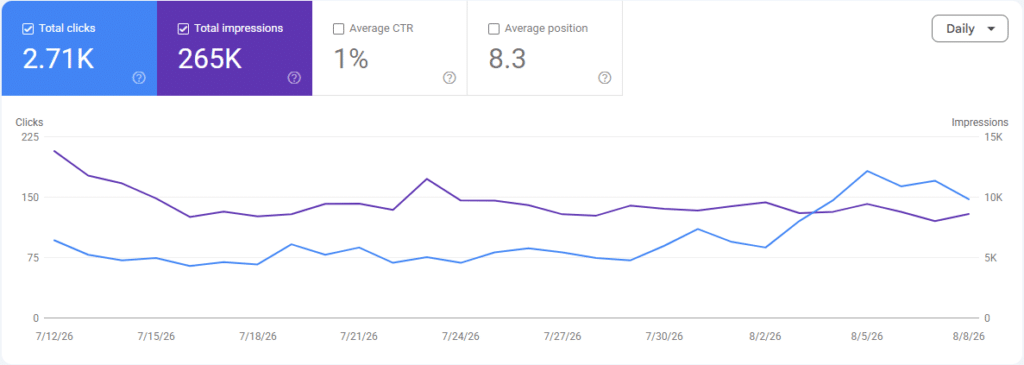
In a recent SEO campaign for a lifestyle and fashion website, our team generated 265,000 search impressions and 2,710 organic clicks within 28 days, while maintaining an average Google ranking position of 8.3. This highlights how consistent SEO optimization can improve search visibility and drive qualified traffic, even in highly competitive niches.
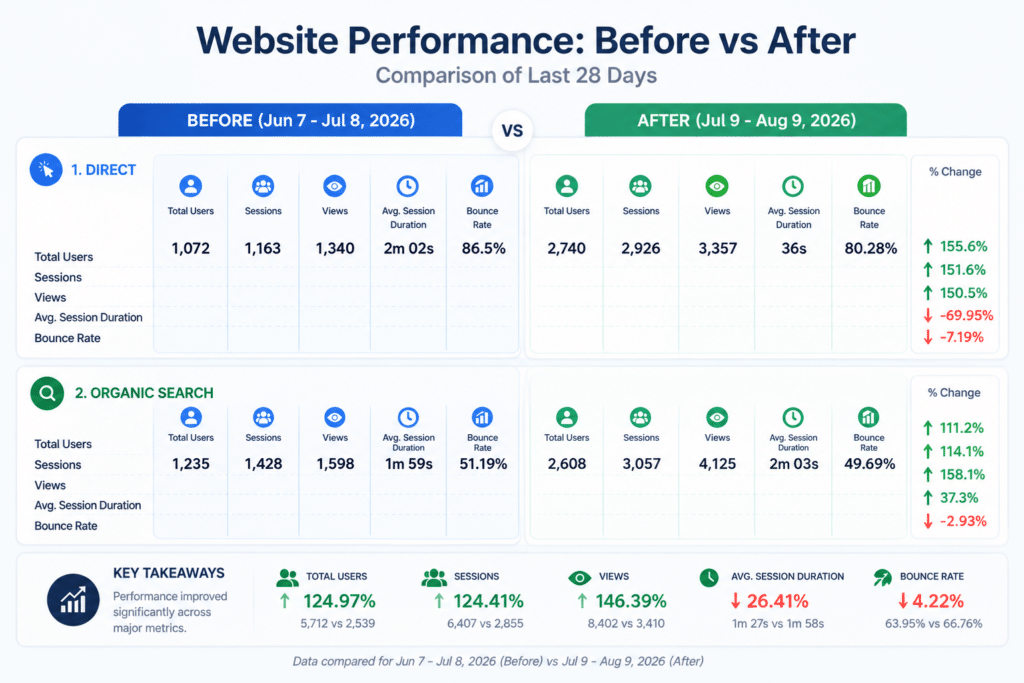
Organic traffic growth examples:
Key Takeaways
-
-
- Organic search is still king, but visibility now matters as much as clicks — AI Overviews are changing how traffic gets earned, not eliminating the channel.
- Local SEO delivers the fastest ROI for businesses with a physical presence — and a complete, active Google Business Profile is the highest-leverage activity available.
- Content marketing beats paid advertising on ROI, but only businesses with real attribution can prove it.
- Backlinks remain a top-three ranking factor, and quality-over-quantity link building consistently outperforms volume tactics.
- PPC costs are rising, but conversion rate optimization protects margins better than budget increases alone.
- Social platforms now serve distinct audience intents — matching content format to platform beats posting everywhere identically.
- AI adoption in marketing is now standard practice, and the businesses pulling ahead are building structured processes around it, not just experimenting.
-
Frequently Asked Questions
01
What is the most important digital marketing statistic for 2026?
02
How much of my traffic should come from organic search?
03
Is SEO still worth investing in with AI search growing?
04
How important is Google Business Profile for local SEO?
05
What's a good conversion rate for Google Ads?
06
How many backlinks does a page need to rank?
07
Is content marketing still effective in 2026?
08
Which social media platform has the best engagement rate?
09
How many marketers are currently using AI tools?
10
How often should these digital marketing statistics be updated?
Conclusion
Digital marketing in 2026 isn’t defined by any single number in this report — it’s defined by the pattern across all of them. Search is fragmenting into traditional results and AI-generated answers. Paid costs are rising while conversion rate becomes the real lever for efficiency. Content and local SEO remain some of the highest-ROI channels available, provided businesses actually measure what’s working.The businesses pulling ahead this year aren’t the ones chasing every new platform or algorithm update. They’re the ones building an integrated strategy across SEO, content, local, paid, and social — and using data like this to make decisions instead of guesses.
Need help growing your business online? Contact Geniefolks Technologies for SEO, Local SEO, PPC, Content Marketing, Social Media Marketing, and Website Development services built around exactly the kind of data-backed strategy in this report.